Estepona Orchidarium: Tropical Orchids, Tickets & What to Know Before You Visit
Step inside the Estepona Orchidarium and the Mediterranean landscape outside suddenly gives way to a subtropical world of orchids, waterfalls, vertical gardens and tropical vegetation.
Known in Spanish as the Orquidario de Estepona, this botanical attraction sits right in the centre of Estepona and contains one of the city's most unusual collections.
More than 1,500 species of orchids are represented by over 4,000 orchids on display, ranging from tiny flowers that are easy to overlook to colourful species from tropical regions around the world.
But the orchids are only part of the experience.
Inside you will also find giant-leaved tropical plants, more than 300 square metres of vertical gardens, a water-lily pond, three glass domes and a waterfall approximately 15 metres high.
The surrounding botanical park expands the green space even further.
The result is a compact attraction that works particularly well as part of a wider walking day through central Estepona.
Here is everything you need to know before visiting the Estepona Orchidarium.
Address: Calle Terraza, 86, 29680 Estepona, Málaga, Spain
Opening: Tuesday–Sunday; closed Monday
Adult admission: €5
Children aged 6–12: €3
Pensioners: €3
Visitors with recognised disabilities: €3
Recommended visit: Approximately 45–75 minutes
Best for: Nature lovers, couples, families, photographers and botanical enthusiasts
Official information: Estepona Tourism – Botanical Park & Orchidarium
What Is the Estepona Orchidarium?
The Estepona Orchidarium is a botanical attraction dedicated primarily to orchids and subtropical plants.
Its indoor space covers approximately 1,000 square metres.
Inside, the environment has been designed to recreate tropical growing conditions.
Orchids grow around tree trunks, large tropical leaves fill the interior and water forms an important part of the landscape.
Rather than presenting every plant in individual pots with labels, much of the collection is incorporated into the wider botanical environment.
That makes the experience feel closer to walking through a tropical garden than visiting a conventional flower exhibition.
More Than 1,500 Orchid Species
The numbers are impressive.
Official Estepona Tourism information currently describes a botanical collection containing more than 1,500 orchid species, represented by over 4,000 orchids on display.
The collection includes plants originating from tropical regions stretching from Central and South America to Australia.
That diversity matters because orchids are an enormous and highly varied plant family.
Do not expect every flower to look like the large decorative orchids commonly sold in European garden centres.
Some are dramatic and colourful.
Others are tiny.
Some flowers require you to look very closely before you notice their shape and detail.
The best way to explore the Estepona Orchidarium is therefore slowly.
Are All 4,000 Orchids Flowering at the Same Time?
No.
This is an important expectation to manage.
The Orchidarium contains thousands of orchids, but plants flower according to their own cycles.
You should not expect every orchid to be in bloom simultaneously.
The appearance of the collection changes throughout the year.
That is actually one of the strengths of a living botanical collection.
Return during another season and different species may be flowering.
For visitors, the practical lesson is simple:
Enjoy the botanical environment as a whole rather than judging the attraction only by the number of flowers open on the day of your visit.
Look Up at the Glass Domes
The architecture is an important part of the experience.
The Estepona Orchidarium has three glass domes.
The tallest rises approximately 30 metres.
From inside, the height helps create the feeling of a much larger tropical environment.
It also allows taller vegetation to become part of the interior landscape.
Take a moment to look upwards rather than concentrating exclusively on the orchids at eye level.
The combination of glass, tropical plants and natural light is one of the most distinctive visual elements of the building.
See the Indoor Waterfall
Another major feature is the waterfall.
Official tourism information describes an indoor waterfall approximately 15 metres high.
Water moves through the botanical environment and contributes to the humid tropical atmosphere.
Combined with the water-lily pond and dense planting, it helps make the Orchidarium feel more immersive than a simple greenhouse.
For children, the waterfall may initially be more impressive than the orchids.
That is fine.
Use it as the starting point for exploring the plants around it.
Discover the Vertical Gardens
The Orchidarium also contains more than 300 square metres of vertical gardens.
These planted walls are worth examining closely.
Vertical planting allows a large number of species to grow within a relatively compact footprint and reinforces the sense that vegetation surrounds you rather than simply occupying flowerbeds on the floor.
Look for differences in leaf shape, texture and colour.
Orchids may be the headline attraction, but the surrounding tropical plants are essential to the overall experience.
One of Europe's Major Public Orchid Collections
Estepona Tourism describes the collection as the largest collection of living orchids exhibited to the public in Europe, and one of the largest internationally.
That is a significant distinction for an attraction in a relatively small Costa del Sol city.
It also explains why the Orchidarium deserves more attention than simply being treated as a rainy-day alternative.
You do not need to be a specialist botanist to appreciate it.
But visitors with a serious interest in orchids and tropical plants have even more reason to include it in their Estepona itinerary.
Is the Estepona Orchidarium Good for Children?
Yes, although the experience is very different from a theme park or zoo.
Children who enjoy nature can look for unusual flowers, large leaves, water features and different plant shapes.
Turn the visit into a simple observation challenge.
Can they find the smallest orchid?
The strangest flower?
The largest leaf?
The tallest plant?
This usually works better than expecting younger children to read botanical information throughout the visit.
Because the attraction is compact, it is also manageable for families.
You are not committing to several hours of continuous walking.
How Long Do You Need at the Estepona Orchidarium?
For most visitors, allow approximately 45–75 minutes.
Botanical enthusiasts and photographers may stay longer.
Visitors simply walking through the main areas could finish sooner.
We recommend avoiding that.
Slow down enough to notice the smaller flowers and details.
The Orchidarium works best as one component of a larger Estepona itinerary rather than the only attraction you visit that day.
Its central location makes that very easy.
Estepona Orchidarium Opening Hours
The current official opening schedule is:
Monday: Closed
Tuesday–Saturday:
10:00–13:30
15:00–18:00
Sunday and public holidays:
10:00–14:00
The afternoon closure from Tuesday to Saturday is important.
Do not arrive around 14:00 expecting continuous opening throughout the day.
Schedules can also change for events or special dates.
Check the official Estepona Tourism information shortly before visiting.
How Much Are Estepona Orchidarium Tickets?
Current official admission prices are:
Adults: €5
Children aged 6–12: €3
Pensioners: €3
Visitors with recognised disabilities: €3
That makes the Estepona Orchidarium one of the more affordable paid attractions in this part of the Costa del Sol.
For a couple, standard admission currently costs only €10 in total.
For families, the relatively low ticket price also makes it easy to combine the Orchidarium with several free experiences elsewhere in Estepona.
When Is the Best Time to Visit?
Morning is the easiest option.
Arriving after 10:00 gives you plenty of time before the midday closure.
You can then continue directly into Estepona's historic centre.
Another option is to visit shortly after the attraction reopens at 15:00 from Tuesday to Saturday.
That can work particularly well in summer.
Spend lunchtime elsewhere, explore the indoor tropical environment during part of the warmer afternoon and return to the streets later.
Because the Orchidarium is indoors, weather is less important than for most Costa del Sol attractions.
Explore the Botanical Park Outside
Do not immediately leave after exiting the building.
The wider botanical park surrounding the Orchidarium expands the experience beyond the indoor collection.
Official Estepona information describes the entire botanical park as covering approximately 16,230 square metres.
The surrounding gardens form part of Estepona's broader emphasis on urban planting and green public spaces.
And unlike the indoor Orchidarium, Estepona's public parks are generally free to explore.
This transition from indoor tropical collection to outdoor Mediterranean city garden works particularly well.
Why Is Estepona Called the Garden of the Costa del Sol?
Walk beyond the Orchidarium and the nickname quickly makes sense.
Estepona has invested extensively in plants, flowers and pedestrian spaces throughout the urban centre.
The municipality currently highlights more than 100 hectares of public green space and around 130 renovated streets in the historic centre filled with plants and flowers.
So the Orchidarium is not an isolated botanical attraction.
It fits into a much larger identity.
Flowers continue through the streets outside.
That connection is one reason the attraction works so naturally as the starting point for exploring central Estepona.
Walk into Estepona Old Town
After your visit, continue on foot towards the historic centre.
You do not need a strict route.
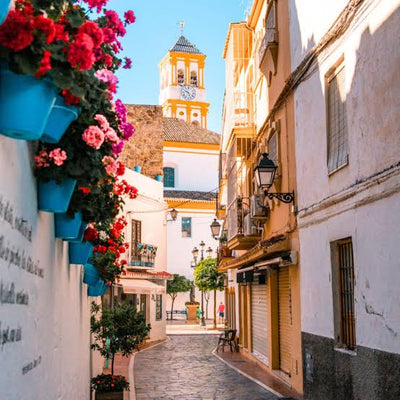
Part of the pleasure is simply following the pedestrian streets and discovering small squares, colourful flowerpots and traditional façades.
Look for streets where pots are coordinated in the same colour.
Stop at local squares.
Explore side streets rather than remaining on the busiest route.
The transition is natural:
tropical plants inside → Andalusian flowers outside.
Combine the Orchidarium with the Estepona Murals Route
One of the strongest combinations is completely free.
Estepona has developed a large open-air collection of murals painted across building façades.
The Estepona Murals Route turns the city itself into an outdoor gallery.
Several murals can be found around the wider central area, making them easy to combine with the Orchidarium.
This also creates a useful thematic connection.
Inside, you explore botanical design.
Outside, you explore urban art.
The next Costa Card guide in this series covers the complete Estepona Murals Route, including practical walking advice and some of the most interesting artworks to find.
Follow Estepona's Official Walking Route
Estepona Tourism also publishes its own Paso a Paso walking itineraries.
The official two-hour route specifically includes the Orchid House and murals as one of its stops.
That is useful confirmation that you do not need to treat the Orchidarium as a standalone destination.
It belongs naturally within a walking tour of the city centre.
Depending on your available time, you can combine it with churches, squares, historic streets, public art and Mediterranean viewpoints.
Add Selwo Aventura on Another Day
If plants are only one part of your interest in nature, Selwo Aventura Estepona provides the obvious wildlife counterpart.
The two attractions are very different.
At the Orchidarium, you explore approximately 1,500 orchid species in a compact botanical environment.
At Selwo, more than 700 animals are spread across a large outdoor wildlife park.
We would generally keep them on separate days.
Selwo requires several hours and considerable walking.
The Orchidarium works better as part of a city-centre day.
A Low-Cost Estepona Day
One of the biggest advantages of the Orchidarium is how easily it fits into a budget-friendly itinerary.
Your only major admission cost can be the €5 Orchidarium ticket.
Afterwards, spend the rest of the day exploring free attractions.
For example:
Estepona Orchidarium → botanical park → Old Town → murals → promenade → beach
That is a substantial sightseeing day without repeatedly paying entrance fees.
For couples and families trying to control holiday spending, this is an especially attractive combination.
Example: A Complete Estepona Orchidarium Day
A relaxed itinerary could look like this:
10:00 – Estepona Orchidarium
Explore the orchids, tropical plants, waterfall and vertical gardens.
11:15 – Botanical Park
Spend some time in the surrounding green space.
11:45 – Estepona Old Town
Walk through the pedestrian streets and squares.
13:00 – Lunch
15:00 – Estepona Murals Route
Find several large-scale artworks around the city.
17:00 – Mediterranean promenade
18:00 – Beach or drinks beside the sea
20:00 – Dinner in central Estepona
This gives you nature, architecture, public art, local streets and the Mediterranean for a relatively modest total cost.
Is the Estepona Orchidarium Worth Visiting?
Yes.
Especially if you appreciate plants, photography or attractions that are different from the standard Costa del Sol beach experience.
The Estepona Orchidarium manages to fit an impressive amount into a relatively compact space.
More than 1,500 orchid species.
Over 4,000 orchids on display.
Three glass domes.
More than 300 square metres of vertical gardens.
A tropical pond.
And a waterfall approximately 15 metres high.
Yet you can comfortably experience it in around an hour.
That combination of quality, affordability and location makes it particularly easy to recommend as part of a day in central Estepona.
Where Does Costa Card Fit?
There is one important distinction for Costa Card visitors.
Estepona is not currently a Costa Card participating destination.
The Estepona Orchidarium therefore does not offer a Costa Card benefit, and you should not purchase Costa Card specifically for this attraction.
Instead, treat Estepona as part of a wider Costa del Sol itinerary.
After exploring Estepona, you might continue east towards Marbella, Mijas, Fuengirola, Benalmádena, Torremolinos or Málaga — all destinations where Costa Card can become relevant.
For example, nearby Marbella offers a completely different collection of experiences.
Explore Marbella Old Town, continue towards Puerto Banús or discover Cabopino and the Artola Dunes.
That is where Costa Card can become part of the next stage of your holiday.
From Tropical Garden to Mediterranean Streets
Start beneath a 30-metre glass dome surrounded by tropical orchids.
Walk through a botanical park.
Continue into flower-filled Andalusian streets.
Find enormous murals painted across buildings.
Then finish beside the Mediterranean.
Few itineraries explain Estepona's modern identity better.
The city has turned gardens, flowers and public art into attractions in their own right.
The Estepona Orchidarium is the perfect place to start discovering them.
Travelling further along the Costa del Sol afterwards? Explore Costa Card to discover participating experiences, routes and benefits in Marbella, Mijas, Fuengirola, Benalmádena, Torremolinos and Málaga.
Planning to explore several participating destinations? Choose your Costa Card Day Card or Week Card here.