Estepona Murals: Discover Estepona's Open-Air Art Gallery
Walk through Estepona and you may suddenly find an enormous painting covering the entire side of an apartment building. Continue a few streets further and another appears. Then another.
Welcome to the Estepona Murals Route, or Ruta de Murales Artísticos: an open-air collection of large-scale artworks spread across different neighbourhoods of the city.
Instead of concentrating art inside a museum, Estepona has transformed walls, residential buildings and public spaces into canvases.
The result is one of the most unusual free things to do in Estepona.
There is no entrance.
There are no fixed opening hours.
And you do not need to find every artwork to enjoy the experience.
Choose several murals, walk between them and combine the route with Estepona Old Town, the Orchidarium, cafés, parks and the Mediterranean.
Here is how to explore the Estepona Murals Route.
Location: Different streets and neighbourhoods across Estepona, Málaga, Spain
Cost: Free
Opening hours: Accessible throughout the day
Recommended time: Approximately 1–3 hours
Best for: Art, walking, photography, couples, families and free sightseeing
Official route: Turismo Estepona – Ruta de Murales
Official map: Available through the Estepona Tourism murals brochure
What Is the Estepona Murals Route?
The Estepona Murals Route is a collection of large-scale public artworks painted across façades throughout the city.
Estepona Tourism describes the project as an open-air museum that offers a different way to experience art.
That description is accurate.
You do not enter one building and move between galleries.
The city becomes the gallery.
Walking from one mural to another takes you through residential streets and neighbourhoods that many visitors would otherwise never explore.
That is one of the route's biggest strengths.
The murals are attractions themselves, but the journey between them also introduces you to another side of Estepona.
Why Does Estepona Have So Many Murals?
The murals form part of a much wider transformation of Estepona's urban environment.
Over recent years, the city has invested heavily in pedestrian streets, flowers, public art, sculptures, poetry and green spaces.
The objective goes beyond decorating individual buildings.
Public space itself has become part of the visitor experience.
The Murals Route fits directly into that philosophy.
Large blank façades that could easily have remained anonymous have instead become enormous artworks.
This also distributes sightseeing beyond the historic centre.
Visitors have a reason to walk into other neighbourhoods rather than remaining only around the most obvious tourist streets.
How Should You Explore the Estepona Murals Route?
Do not approach the Estepona Murals Route as a checklist.
Trying to find every mural in a single walk can turn an enjoyable experience into a navigation exercise.
Instead, download or consult the official route map and select several artworks that interest you.
Then build a walking route around them.
For a first visit, approximately 1–3 hours is a good amount of time.
One hour allows you to see a selection.
Two or three hours gives you time to walk more slowly, take photographs and explore the surrounding streets.
You can also divide the route across several days.
Because the murals are outdoors, there is no need to complete everything at once.
Look for La Casa de la Buena Gente
One of the interesting works to look for is La Casa de la Buena Gente by artist Conchi Álvarez.
The mural can be found around Calle Tres Banderas.
It uses a trompe-l'œil approach.
This artistic technique creates an optical illusion that makes painted architectural elements appear more three-dimensional or real than they actually are.
That means you should not only look at the subject.
Look at how the mural interacts with the building itself.
Windows, balconies and architectural lines can become part of the artwork.
This relationship between painting and architecture is one of the most interesting aspects of large-scale street art.
Location: Calle Tres Banderas area, Estepona, Málaga, Spain
Find Simbiosis
Another work associated with the route is Simbiosis, created by José Fernández Ríos.
The mural is located around Plaza del Ajedrez.
Its subject connects art with the natural environment and the pinsapo, the Spanish fir strongly associated with the mountains of southern Andalucía.
This is a good example of why the Estepona Murals Route deserves more attention than simply being treated as colourful decoration.
Individual works can refer to local landscapes, culture, people or broader artistic ideas.
The more closely you look, the more the route becomes an introduction to the identity of the region.
Location: Plaza del Ajedrez area, Estepona, Málaga, Spain
Discover Profundo
Public art does not always need to be painted vertically on a wall.
Profundo, by artist Eneko Azpiroz, takes a different approach around Plaza del Ayuntamiento.
The work demonstrates how the wider murals and public-art programme can interact with urban space rather than simply covering conventional façades.
This makes Plaza del Ayuntamiento a useful stop while exploring central Estepona.
It is also close enough to other central attractions that you can incorporate it naturally into a wider walking day.
Location: Plaza del Ayuntamiento, Estepona, Málaga, Spain
Look for El Pescador Moderno
Estepona's relationship with the Mediterranean is an important part of the city's identity.
That makes El Pescador Moderno, by Juan Pineda, an interesting work to include.
Its fishing theme connects naturally with Estepona's coastal history.
Before tourism became one of the defining industries of the Costa del Sol, fishing communities played an important role in towns along this coastline.
Public art can therefore do something useful:
make visitors think about the place behind the modern resort destination.
Location: Calle San Juan Bosco area, Estepona, Málaga, Spain
Find the Mural Estepona
Another work worth including is Estepona, by Curro Leyton.
Its location towards the port and lighthouse side of the city makes it particularly useful if you want to extend your mural walk towards the Mediterranean.
Instead of finishing the route in the urban centre, continue towards the coast.
This creates a natural progression:
murals → port → lighthouse → Mediterranean promenade
You are no longer simply walking between paintings.
You are using the artwork to explore Estepona itself.
Take the Official Map with You
This is one attraction where having a map genuinely improves the experience.
The murals are distributed across different streets and neighbourhoods.
You will not simply encounter all of them by walking down one main avenue.
Estepona Tourism provides an official Ruta de los Murales brochure that can be used to locate the artworks.
Use it as a guide rather than a strict itinerary.
Select the murals that interest you most.
Look at where they are located.
Then connect them with other places you already want to visit.
That is much more efficient than walking back and forth across the city trying to complete the entire collection.
Is the Estepona Murals Route Free?
Yes.
Exploring the Estepona Murals Route is completely free.
The artworks are displayed in public space, so there is no entrance ticket.
This makes the route particularly useful when balancing your holiday budget.
Spend money on attractions you genuinely want to experience and combine them with free city highlights such as the murals.
There is also no requirement to book a guided tour.
You can follow the official map independently and decide your own pace.
What Time Can You See the Murals?
Because the artworks are outdoors, there are no conventional attraction opening hours.
Technically, you can walk past them at any time.
For actually seeing and photographing them, daylight is obviously preferable.
During summer, early morning and late afternoon are particularly attractive.
Temperatures are lower and the light can be more suitable for photography.
Midday can be hot, especially when walking between neighbourhoods with limited shade.
In winter, the middle of the day may actually be ideal.
Photography Tips for the Estepona Murals Route
Large murals can be surprisingly difficult to photograph.
The biggest problem is usually space.
Some artworks cover enormous façades, but the street in front of them may not provide enough distance to capture everything easily.
Try several positions.
Walk further away.
Use surrounding buildings or people to show scale.
And do not assume the most obvious straight-on photograph is automatically the best.
The relationship between the artwork and its neighbourhood is part of the story.
Cars, balconies, windows and streets can sometimes make the photograph more interesting rather than less.
Is the Route Good for Children?
Yes, particularly if you turn it into a search rather than a formal art tour.
Give children several murals to find on the map.
Let them choose their favourite.
Ask which one they would paint on their own house.
Because the artworks are often enormous, they are immediately more accessible to younger visitors than a long sequence of paintings inside a museum.
There is another advantage.
You remain outdoors and keep moving.
If attention starts to disappear, stop for something to eat, visit a park or head towards the beach.
There is no ticket forcing you to stay.
Combine the Murals with the Estepona Orchidarium
One of the strongest combinations is the Estepona Orchidarium.
The Orchidarium contains more than 1,500 orchid species, thousands of individual orchids, tropical vegetation, vertical gardens and a large indoor waterfall.
Allow roughly an hour there.
Then continue outside and start exploring the murals.
This creates an excellent contrast:
living botanical art → urban street art
Both also connect with Estepona's wider transformation into a city where public spaces, flowers and design form an important part of the visitor experience.
Explore Estepona Old Town
Do not spend the entire day looking upwards at walls.
Make time for Estepona's historic centre.
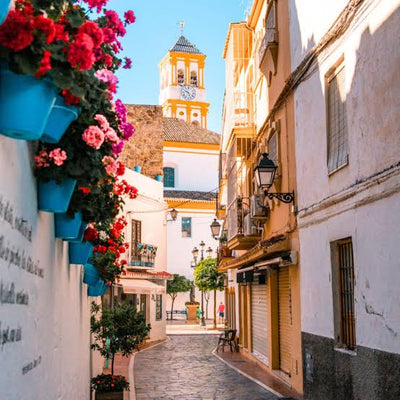
Whitewashed streets, flowerpots, pedestrian areas and small squares make the Old Town one of the most enjoyable parts of the city to explore on foot.
You do not need a strict route.
In fact, getting slightly lost is part of the appeal.
Use several murals as navigation points and explore the streets between them.
Stop for coffee.
Have lunch.
Walk into a square that was not on your original itinerary.
This is where the Murals Route becomes more than an art trail.
It becomes a way to discover Estepona.
Look for More Public Art
The murals are only one part of Estepona's outdoor cultural landscape.
The city also promotes separate routes dedicated to sculptures and poetry.
That means you may encounter other artworks while searching for murals.
Do not ignore them because they are not on your original list.
Estepona Tourism deliberately presents these different routes as complementary ways to explore the city.
For art lovers, it is possible to build an entire day around public art without entering a traditional museum.
Continue Towards the Mediterranean
Eventually, let the route take you towards the coast.
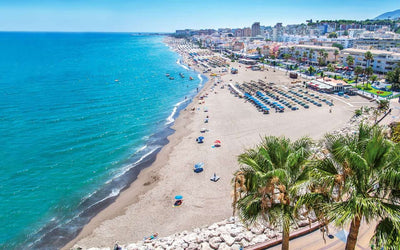
Estepona's promenade provides a completely different environment from the residential streets where many murals are found.
Walk beside the Mediterranean.
Continue towards the port.
Or simply find somewhere to sit and watch the sea.
This is one of the benefits of exploring Estepona on foot.
Distances between experiences are often manageable enough that your sightseeing day can naturally transition into a beach or promenade afternoon.
Combine the Murals with Selwo Aventura
If you are staying in Estepona for more than one day, keep Selwo Aventura Estepona for a separate day.
Selwo is a substantial wildlife attraction with more than 700 animals and requires several hours.
The two experiences could hardly be more different.
Selwo: wildlife, landscapes and a major paid attraction.
Murals Route: city streets, art and completely free exploration.
That makes them complementary rather than competing activities.
A two-day Estepona itinerary can easily include both.
A Free Art Day in Estepona
One of the strongest features of the Estepona Murals Route is how little you need to spend.
You can combine:
Estepona Old Town
Ruta de Murales Artísticos
public sculptures
poetry route
promenade
beach
without paying an entrance fee for any of them.
Add only the €5 adult admission to the Orchidarium and you have an extremely varied sightseeing day for very little money.
That makes Estepona particularly attractive for travellers who want to experience more without filling every day with expensive attractions.
Example: A Complete Estepona Murals Day
A relaxed itinerary could look like this:
10:00 – Estepona Orchidarium
Start with tropical plants and orchids.
11:15 – Begin the Estepona Murals Route
Use the official map and select several nearby artworks.
12:30 – Estepona Old Town
Explore the pedestrian streets and squares.
13:30 – Lunch
15:00 – Continue the Murals Route
Walk towards another cluster of artworks.
16:30 – Public sculptures and poetry
Look for other pieces of outdoor art along the way.
17:30 – Head towards the port
18:30 – Mediterranean promenade
Finish the sightseeing part of your day beside the sea.
20:00 – Dinner in Estepona
You do not need to follow these times precisely.
That freedom is one of the advantages of an outdoor art route.
Is the Estepona Murals Route Worth Doing?
Yes, particularly because the Estepona Murals Route asks very little from you.
There is no ticket.
There is no reservation.
There is no fixed start time.
And you do not need to complete the entire route.
Choose several artworks and start walking.
Along the way, you discover streets and neighbourhoods that you might otherwise never visit.
That is what makes the project work.
The murals are not simply decorations added to tourist attractions.
They turn ordinary parts of the city into places worth exploring.
Where Does Costa Card Fit?
There is an important distinction for anyone discovering this article through Costa Card.
Estepona is not currently one of Costa Card's participating destinations.
The murals themselves are free anyway, so no discount is required.
You should therefore not purchase Costa Card specifically for an Estepona day.
Instead, use Estepona as part of a wider Costa del Sol itinerary.
When you continue towards participating destinations such as Marbella, Mijas, Fuengirola, Benalmádena, Torremolinos or Málaga, Costa Card becomes relevant.
Marbella is the most obvious next stop.
Continue Your Trip in Marbella
After exploring Estepona, discover Marbella Old Town.
The contrast works particularly well.
Estepona uses large-scale contemporary murals to transform modern city façades.
Marbella Old Town gives you narrow historic streets, whitewashed buildings and Plaza de los Naranjos.
From there, walk towards Avenida del Mar and its Dalí sculptures.
You can therefore continue the public-art theme in another city.
Prefer Marbella's more famous modern image?
Visit Puerto Banús.
Or choose nature and explore Cabopino and the Artola Dunes together with Playa de Cabopino.
Turn the Costa del Sol into a Journey
The best Costa del Sol holidays are not built around one type of attraction.
Walk between enormous murals in Estepona.
Explore Marbella's whitewashed Old Town.
See Dalí sculptures for free.
Walk through protected dunes at Cabopino.
Then add the paid experiences you genuinely want to do.
When your trip continues into Costa Card's participating destinations, explore Costa Card to discover activities, routes and current benefits.
Choose the Day Card when you want to concentrate several participating benefits into one day.
Choose the Week Card when you are exploring multiple participating destinations during your holiday.
Ready to experience more and pay less? Choose your Costa Card Day Card or Week Card.