Málaga Alcazaba & Roman Theatre: Complete Guide
There are few places where Málaga's history becomes as visible as it does on Calle Alcazabilla. At street level stands a Roman theatre dating back to the first century. Directly behind it, the walls of the Alcazaba of Málaga climb up the hillside towards Gibralfaro.
Roman and Islamic Málaga are literally layered on top of each other. That makes the Málaga Alcazaba and Roman Theatre one of the most important historical areas to visit anywhere on the Costa del Sol.
The Roman Theatre can be visited for free, while the Alcazaba allows you to walk inside one of Málaga's most significant monuments.
Here is how to experience both.
Location: Calle Alcazabilla, 29015 Málaga, Spain
Best for: History, culture, couples, families and photography
Roman Theatre: Free admission
Alcazaba: Paid admission; free Sundays from 14:00
Recommended time: 2–3 hours
Why Visit the Málaga Alcazaba and Roman Theatre Together?
Because their location tells the story.
The Roman Theatre of Málaga was constructed during the early Roman Empire in the first century AD.
Centuries later, during Málaga's Islamic period, the Alcazaba developed above it as a fortified complex and eventually became a palace-fortress and seat of government.
Materials from the Roman Theatre were even reused in the Alcazaba.
Today, standing on Calle Alcazabilla allows you to see both periods simultaneously.
It is difficult to find a better visual introduction to Málaga's history.
Start at the Roman Theatre of Málaga
Begin at street level.
The Roman Theatre is the main surviving monument of Roman Málaga and was constructed during the early years of the Roman Empire.
The theatre remained in use for centuries before eventually being abandoned.
And then it disappeared.
For centuries, much of the structure remained buried beneath later development. It was rediscovered in 1951 during works around the Casa de la Cultura.
Today, the archaeological site and interpretation centre allow visitors to explore this part of Roman Málaga again.
Address: Calle Alcazabilla, s/n, 29015 Málaga
Admission: Free
Even if you have limited time, you can also see the theatre from Calle Alcazabilla itself.
Look Up Towards the Alcazaba
Once you have explored the Roman Theatre, look directly behind it.
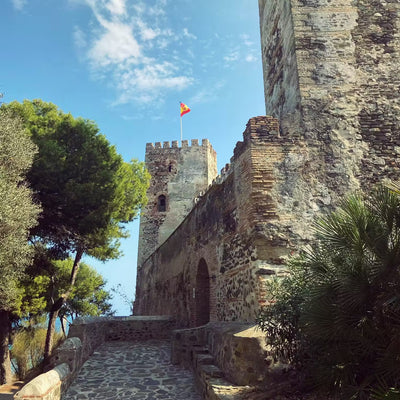
Above you is the Alcazaba of Málaga.
Its name derives from the Arabic al-Qasba, meaning urban fortress.
The hill had already attracted earlier civilisations, including Phoenician and Roman settlement, before the Alcazaba became one of the defining structures of Islamic Málaga.
The complex evolved from a fortification into a palace-fortress and seat of city government.
This was not simply a castle on a hill.
It was a political, residential and defensive centre.
Explore Inside the Alcazaba
Entering the Alcazaba allows you to experience the site very differently.
Instead of only seeing the defensive walls from below, you move through gateways, courtyards, gardens and fortified spaces as you gradually climb.
Look for architectural details rather than rushing directly to the highest point.
Arches, walls, small gardens and framed views across Málaga make the Alcazaba as interesting visually as it is historically.
From the higher areas, you also gain views towards the city and port.
Allow at least an hour for the Alcazaba itself.
Understand the Connection with Gibralfaro
Look further uphill and you will see another important part of Málaga's defensive landscape: Castillo de Gibralfaro.
The Alcazaba and Gibralfaro were connected by the Coracha, a protected passage formed by parallel defensive walls climbing the hillside.
Gibralfaro's elevated position provided additional protection and observation over the city and approaches from land and sea.
If you have enough time and energy, combining the Alcazaba with Gibralfaro creates a much more complete historical experience.
A combined ticket is available for both monuments.
How Much Does the Alcazaba Cost?
At the time of writing, the official general admission price for the Alcazaba is €7.
A combined Alcazaba + Castillo de Gibralfaro ticket costs €10.
Reduced rates are available for eligible visitors.
There is also a useful option for budget travellers:
Admission is currently free on Sundays from 14:00.
Opening hours vary between the winter and summer seasons, so check the official information before visiting.
Walk Along Calle Alcazabilla
Do not immediately leave after visiting the monuments.
Calle Alcazabilla itself is one of the most attractive streets in Málaga's historic centre.
The Roman Theatre and Alcazaba dominate one side, while cafés and restaurants make the area a natural place to stop afterwards.
You are also within walking distance of Plaza de la Merced, Málaga Cathedral and the Picasso Museum.
This is why we recommend treating the entire Alcazaba and Roman Theatre area as a highlight rather than visiting each monument in isolation.
When Is the Best Time to Visit?
Morning is an excellent option, particularly during warmer months.
You can explore the archaeological area before the strongest heat arrives and continue into the historic centre afterwards.
Late afternoon can also be beautiful because of the changing light across the stone walls.
If budget is important, Sunday afternoon has the obvious advantage of free Alcazaba admission from 14:00.
How Long Do You Need?
Allow approximately two to three hours for the complete area.
Spend around 30–45 minutes at the Roman Theatre and interpretation centre before allowing at least an hour for the Alcazaba.
Add more time if you want to take photographs or explore slowly.
If you continue to Gibralfaro afterwards, turn it into a half-day historical route.
Create a Historic Málaga Walking Route
The compact city centre makes it easy to combine several highlights.
Try:
Calle Larios → Málaga Cathedral → Roman Theatre → Alcazaba → Málaga Park → Muelle Uno
Almost the entire route can be completed on foot.
For more ways to keep costs down while sightseeing, our free and budget-friendly Málaga guide includes several of these locations.
Is the Málaga Alcazaba Worth Visiting?
Absolutely.
If you only visit one historical complex in Málaga, this area should be high on your list.
The Roman Theatre shows the city's Roman past at street level. The Alcazaba then takes you centuries forward into Islamic Málaga.
And the remarkable part is that you can see both periods in the same view.
Take your time here.
This is not simply somewhere to photograph — it is one of the best places to understand why Málaga is much more than a beach destination.
Continue Exploring Málaga
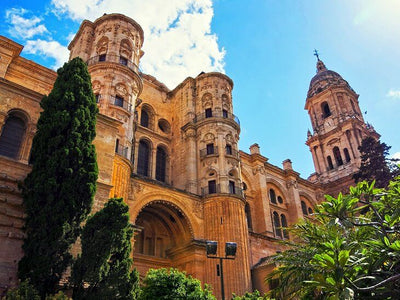
Afterwards, continue towards the Cathedral and historic centre or walk through Málaga Park towards Muelle Uno.
For a different way to experience the city, Costa Card's City & Culture route combines sightseeing with several local experiences.
Discover more through Costa Card and combine Málaga's free and historical highlights with selected activities across the city.
Experience more. Pay less.